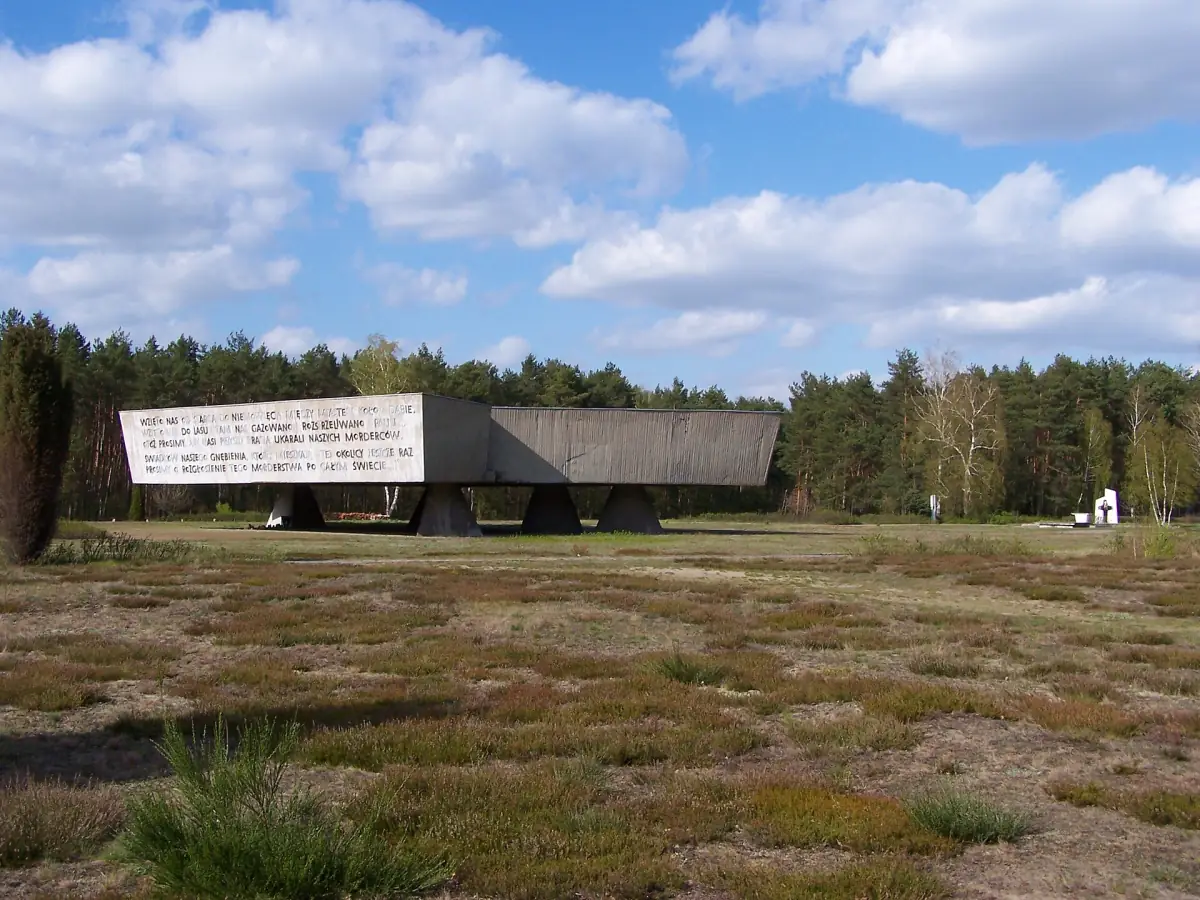

Kulmhof, a German extermination camp in occupied Poland
Kulmhof was the German name of the extermination camp in the village of Chełmno nad Nerem, in today's Greater Poland region. It is not the town of Chełmno on the Vistula. The first transport arrived on 7 December 1941, and the killings began on 8 December 1941. German perpetrators murdered the people brought here in gas vans, using carbon monoxide from the engine exhaust.
Most of the victims were Jews from the Warthegau, as the German occupiers called the region, and from the Łódź Ghetto. Roma, non-Jewish Poles and Soviet prisoners of war were also murdered at Kulmhof. The exact total number of victims is unknown.


The camp from 1941 to 1945
The main stages in chronological order, with the dates given by the memorial and by the United States Holocaust Memorial Museum (USHMM).
7 and 8 December 1941: the first transport
The first transport reached Kulmhof on 7 December 1941. The killings began on 8 December 1941. The USHMM distinguishes between these two dates. The perpetrators used gas vans in which the victims were killed with carbon monoxide from the engine exhaust.
From 16 January 1942: transports from Łódź
The memorial describes transports that left Radegast station in Łódź, ran via Kutno to Koło, and continued from there to Kulmhof from 16 January 1942. The USHMM documents deportations from Łódź to Kulmhof during 1942.
April 1943: the end of the first phase
The first phase of the camp ended in April 1943. The palace in the village was blown up on 7 April 1943.
June 1944: the second phase
The killings resumed in June 1944. In this second phase they took place mainly in the forest camp in the Rzuchów forest, about 4 km from the village. According to the USHMM, deportations from Łódź to Kulmhof took place again in June and July 1944. In August 1944, most of the remaining inhabitants of the ghetto were deported to Auschwitz-Birkenau instead.
17 to 18 January 1945: the last killings
The last killings took place in the night of 17 to 18 January 1945 at the granary in the village. The camp operated until January 1945.
The victims of Kulmhof
According to the USHMM, the victims were above all Jews from the Warthegau and from the Łódź Ghetto. Among them were Jews from other European countries who had first been deported to Łódź. Roma were also murdered at Kulmhof, as were non-Jewish Poles and Soviet prisoners of war. For the Soviet prisoners of war there is no reliable figure.
Children from the Czech village of Lidice were also brought to Kulmhof. Yad Vashem gives their number as 88. The USHMM describes their murder at Kulmhof as probable and gives no number.
The figures on this page are not exact counts. They are estimates and minimum figures that the institutions arrive at in different ways. The USHMM states that the exact total is unknown.
How many people were murdered at Kulmhof
The memorial and the USHMM use different estimates and categories. The figures should not be added together or reduced to a single number.
| Institution | Figure | What it refers to |
|---|---|---|
| USHMM | At least 152,000 | Jewish victims |
| USHMM | About 4,300 | Roma |
| USHMM | At least 156,300 | All victims; the exact total is unknown |
| Memorial | About 200,000 | The total the memorial considers probable |
| Memorial | 350,000 | The result of an early Polish investigation |
| Memorial | 152,000 | The minimum figure from the Bonn proceedings |
When you quote a figure, name the institution and what the figure refers to. The two approaches answer different questions: a documented minimum on one side, a probable total on the other.
Witnesses and trials
Survivors of Kulmhof gave evidence after the war. The USHMM names Szymon Srebrnik and Podchlebnik, whose first name appears as Michał or Mordechai, as witnesses at the Eichmann trial in 1961. Both spellings refer to the same person.
After that, 12 members of the German special detachment at Kulmhof, the Sonderkommando, stood trial in the years 1962 and 1963.
In Poland, the crimes were investigated after the war. The memorial names judge Władysław Bednarz of the district court in Łódź, who led investigations into the crimes at Kulmhof.


From crime site to memorial
The memorial in Chełmno nad Nerem is today a branch of the Muzeum Martyrologiczne w Żabikowie. Its earlier association with the museum in Konin is part of the history of the museum. The museum took over the area in the village in 1998. An exhibition opened in the restored granary in 2009, and the historical permanent exhibition opened on 18 December 2019.
Not every part of the camp survives as a building. The palace was blown up in 1943, and there is no palace today that visitors can walk through. Opening hours, free admission and the rules on site are on the page about visiting the Kulmhof memorial. The route of the deportations from Łódź is explained on the page about the Łódź Ghetto and Radegast station.
The town of Chełmno on the Vistula, which shares the name, is a separate place with no connection to the camp site. Travel to that town is covered on the page about getting to Chełmno on the Vistula.
Continue reading

Visiting the Kulmhof memorial
Opening hours, free admission, guided tours and conduct on site.

The Łódź Ghetto and Radegast station
Deportations from Litzmannstadt to Kulmhof and the memorial at the station.
Photos – Visiting the Kulmhof memorial: Detail of a photo by קובץ על יד · CC BY-SA 4.0; The Łódź Ghetto and Radegast station: Detail of a photo by Zorro2212 · CC BY-SA 4.0


History of Kulmhof: frequently asked questions
When did the Kulmhof extermination camp operate?
In two phases: from December 1941 to April 1943 and from June 1944 to January 1945. The first transport arrived on 7 December 1941, and the killings began on 8 December 1941.
How were people murdered at Kulmhof?
German perpetrators murdered them in gas vans, using carbon monoxide from the engine exhaust.
How many people were murdered at Kulmhof?
The exact number is unknown. The USHMM gives at least 156,300 victims, among them at least 152,000 Jews and about 4,300 Roma. The memorial considers a total of about 200,000 probable.
Where was Kulmhof?
In the village of Chełmno nad Nerem in Greater Poland, in occupied Poland. The crimes took place in the village and in the Rzuchów forest about 4 km away. The town of Chełmno on the Vistula is a different place.
Were children from Lidice murdered at Kulmhof?
Yad Vashem names 88 children from the Czech village of Lidice. The USHMM describes their murder at Kulmhof as probable, without giving a number.
Is this the official website of the memorial?
No. This is an independent visitor guide. For binding information, please contact the memorial directly.